
Beijing In the Lead
China has long linked its development to peace and stability in the world, within the existing world order. Not anymore.

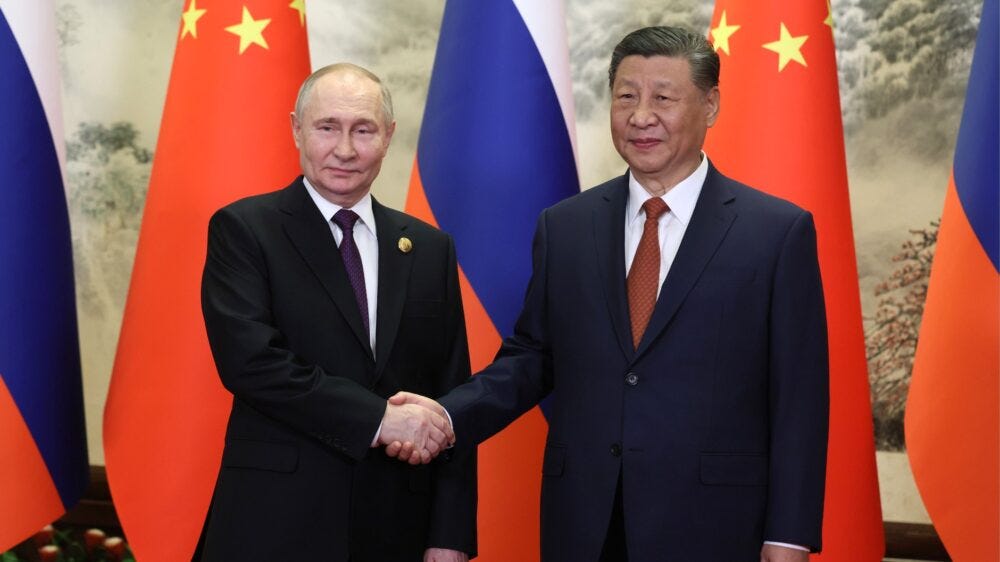
(Vladimir Putin møder Xi Jinping i 2024. Foto: Wikimedia Commons)
Note: This is a translation of our op-ed in Solidaritet, June 2, 2026, written by Frederik Hoedeman, with a small contribution from me.
If there was one clear lesson from the summit between Xi and Trump on May 13-15 and Xi and Putin the following week, it is that old dreams of Chinese supremacy have now come out of the closet. The mood has shifted, and this could prove extremely dangerous for China’s neighbors - beyond Russia. And in the long term also for Europe
US President Donald Trump’s recent visit to Chinese President Xi Jinping in Beijing prompted many European leaders to take notice. Despite their differences, the summit between a weakened Trump and an increasingly comfortable Xi highlighted that they agree on a new world order where the strongest are right and can do as they please.
Meanwhile, Trump’s Chinese visit showed that China has firmly established itself on the throne of world power and succeeded in getting Trump to change 40 years of American Taiwan policy.
Putin’s visit the following week also made headlines. The focus in Western media was that Russia was on its knees economically and in trouble in Ukraine. And that Putin, in his role as a “junior partner,” had to accept that Xi put on “Swan Lake” - the musical symbol of the collapse of the Soviet Union - during the official dinner. Putin once again had to return home empty-handed without making important agreements on the establishment of an additional gas pipeline from Russia to China.
The fact that China and Russia celebrated the 25th anniversary of the “Sino-Russian Treaty on Good-Neighborliness and Friendly Cooperation” with a joint declaration on changing the world order, on the other hand, largely went unnoticed.
China Sets the Stage
For China, however, the most important objective of the two summits was to demonstrate that Beijing is now inevitable when it comes to solving global problems – unlike the US. Therefore, it is no coincidence that in the run-up to the summit, Chinese state media described the US as “corrupt and unaccountable” – two central values for Xi Jinping since he came to power in 2012. During the meeting with Trump, Xi also made no secret of the fact that he sees the US as a weakened superpower.
Therefore, it was also perfect timing for the Sino-Russian declaration of a new world order to replace the previous American-dominated order.
With the declaration, China and Russia showed that they fundamentally share a worldview. First, the two countries emphasize that they share a common view of history, in which “a small group of countries have tried to impose their interests on the rest of the world” and see themselves as “constructive in preserving global stability and strengthening global leadership.”
The declaration refers to the risk of the world community becoming more divided and a return to the “law of the jungle”, with a barely concealed reference to the US. Central to the declaration is also that “differences and conflicts must be resolved peacefully, by addressing the “root causes” and that “it is unacceptable to force sovereign nations to give up their neutral status”.
Where the first passage is a reference to China’s “right to Taiwan,” both passages are a direct reference to the Kremlin’s narrative that Russia’s war of aggression against Ukraine is a legitimate defense against NATO as “the root cause of the conflict” – including the narrative that the West has forced Ukraine to abandon its neutrality towards Russia. Putin has every reason to be satisfied.
China as a Cybertotalitarian World Dominator
In the West, we mostly forget that China – despite all the green, innovation, business success and cheap goods from Temu – is a totalitarian regime with a toptuned propaganda machine. Because as Julian Gewicz, a researcher at Columbia University in the USA, shows in his book “Never Turn Back- China and the Forbidden History of the 1980’s”, we must understand that the Chinese Communist Party’s decision to introduce elements of a market economy wasn’t some kind of entente towards the West.
Rather, it came in response to the collapse of the Soviet Union in 1991 and the risk of a similar collapse of the totalitarian system in China. Over the years it did not, as many Westerners had hoped for, lead to a change of system. On the contrary, as many China-observes underline, it led to its preservation.
We therefore also have difficulty recognizing that the regime does not have benign intentions toward a democratic and free Europe – and equally difficult to understand that Chinese companies are subject to the regime’s interests.
While Europe has benefited for years from the low prices of Chinese-produced rare earths, which are now used in most high-tech products, China has now begun to exploit its monopoly to impose its will internationally where necessary. This could become a major challenge for Europe.
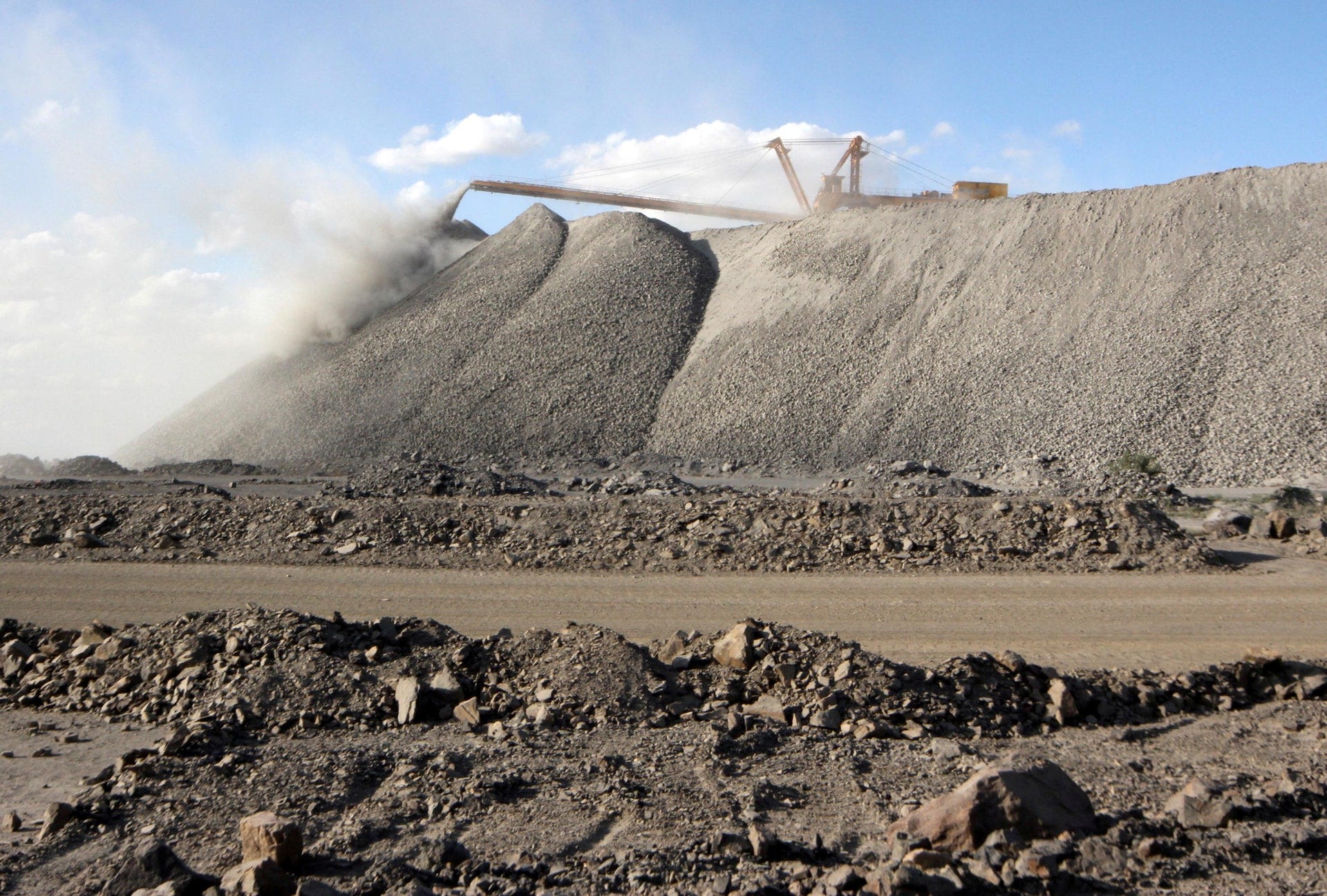
(Foto: A mining machine is seen at the Bayan Obo mine containing rare earth minerals, in Inner Mongolia, China July 16, 2011. REUTERS)
Because without rare metals – no European industry of importance and no European armament and perhaps no Ukrainian defense against Russia. In addition, European election cycles, the short-termism of private companies and American impulse politics do not bode well for Chinese long-termism. Also militarily, which this week prompted the British spy chief Anne Keast-Butler to warn that “rapid Chinese advances in AI are ‘ripping the rug out from under us’”.
Perhaps most importantly, we underestimate the importance of China’s partnership with Russia.
The Strategic Partnership
China and Russia are today each other’s most important partners. After Russia’s escalation in the Russo-Ukrainian war 2022, the Kremlin needed China’s massive domestic market for oil and gas exports as a kind of insurance against the cessation of trade with Europe. Russia also gained secure imports of goods – including drone parts for attacks on Ukraine, which are otherwise impossible to obtain due to Western sanctions.
China, for its part, needs a centrally controlled Russia that provides peace and quiet along the 4,300-kilometer common border. Russia acts as a buffer against the West, and Russia’s war in Ukraine is being used to divert attention from China’s dominance in Asia and, not least, to systematically weaken Europe.
Therefore, it is no coincidence that the Chinese state media China Daily praised Putin’s visit to Beijing last week and what it called the visit “the unchanged historical logic of Sino-Russian friendship.”
It’s more than just rhetoric. According to political scientist, China expert and author of the book “Institutional Genes,” Chengang Xu of the University of Cambridge, Russia and China share a fundamental political culture. In the 14th century, when Mongol warlords dominated modern Russia, Chinese officials from the Empire laid the foundation for the political culture of Russian princes.
It is a culture with long traditions in the Chinese dynasties that would later become characteristic of the Tsardom in Russia: maximum centralization of power around the Tsar, information monopoly, systems for power control with bureaucracy and elites, control of violence through secret networks and services.
Precisely because of the common political roots, Russia succeeded in exporting the communist revolution and the Soviet system to China, where the World Revolution otherwise largely ended in a fizzle.
The Brutal Truth
The common political origin – spiced with Chinese market dominance and Russian imperial dreams and a desire for war – is one of the reasons why the US and the EU are having a very difficult time driving a wedge through the world order that China and Russia seem to want to build together.
The Trump administration’s attempt to divide Russia and China is not just a failure — it is a geopolitical end in itself. Instead of weakening Moscow, Washington has only made itself more isolated, undermined Europe’s trust, and appeared strategically amateurish to both Russia and the rest of the world.
This is the brutal truth about Trump’s foreign policy madness: he speaks the language of strength, yet delivers chaos, weakness, and greater risks to American interests.
A tipping point has been set in motion and it is no coincidence that China sets it in motion now. China wants us to believe that its power, its domination and green and technological greatness, is so overwhelming that all resistance is futile and even undesired.
Now it’s up to Europe to stand tall and face the future.
Sources:
Julian Gewicz: ”Never Turn Back- China and the Forbidden History of the 1980’ies”, Harvard University Press, 2024
Chengang Xu: ”Institutional Genes- origins of Chinas institutions and totalitarianism”, Cambridge University Press, 2025
Andreas Fulda: “Wenn China Angreift- ein Szenario”, C.H. Beck, 2026
China and Russia driving autocratic shift around world, report says - The Japan Times
China — The Real Winner From Russian Victory in Ukraine - CEPA
China quietly eclipsing a weakened Russia in Central Asia - Asia Times
China quietly conquers Russian-occupied oblasts in Ukraine / The New Voice of Ukraine
The Sino-Russian partnership: why it matters for Australian security and defence - ASPI
Op-ed | The Taiwan Trap: Why Beijing Needs Russia’s War in Ukraine - The Foreign Policy Centre
How China, Russia, and North Korea Enable Each Other’s Atrocities – The Diplomat
China-Russia Dashboard: Facts and figures on a special relationship | Merics
Book review – Chip War: The Fight for the World’s Most Critical Technology by Chris Miller
India and Russia Solidify Strategic Ties with RELOS Pact
The Emerging Authoritarian Entente
Latvian State Security Service: Russia recruits criminals, China recruits academics / Article
China’s influence on the US-Iran ceasefire deal - ABC News
Deutsche Bank Declares China Energy ‘Winner’ in New Era of War - Bloomberg
The Chinese Era: How Young People’s Views of China Changed – chinaobservers
China ready to interfere in local elections: NSB - Taipei Times
China is the Iran war’s biggest winner. It never fired a shot
Xiang Biao on a Society at the Edge | China Books Review
Russia Sees China Buying Gas at Discount to Europe Through 2029 - Bloomberg